Pay on deliveryFree delivery 24/48h30-day returns

Pay the courier on deliveryFree express delivery 24/48h30-day returns · 4-year warrantyCustomer support 9:00–18:00 CET
Home comfort
Split air conditioners vs air conditioners without an outdoor unit: the real differences
A classic split, or a single unit with no outdoor box on the facade? We compare installation, efficiency, noise, power and looks to help you understand which type of air conditioner suits your home.
By Odds & Gadgets editorial team10 November 20269 min read

When you start looking for an air conditioner, you quickly come across two very different types. On one side there is the classic split system, with one unit on the wall inside and a second unit outside, on the balcony, the roof or the facade. On the other there are air conditioners without an outdoor unit, often called monoblock or single-unit wall air conditioners: everything sits in one cabinet inside the room, and from the outside you only see two grilles in the wall.
Both cool your rooms in summer, and many models can also heat in winter, but they are designed for different situations. In this guide we look at how they work, how they differ in installation, efficiency, noise and looks, and which questions to ask before choosing.
The differences at a glance
| Classic split | Without an outdoor unit | |
|---|---|---|
| Units | An indoor unit and an outdoor unit, connected by pipes | One single unit inside the room |
| What you see outside | An outdoor unit on the balcony, roof or facade | Two round grilles in the wall |
| Installation | Refrigerant lines connected on site by a certified technician | Two holes in an exterior wall; the refrigerant circuit is sealed at the factory |
| Where it can go | On almost any wall, within the maximum pipe length | Only on an exterior wall |
| Efficiency | Usually the highest | Lower than a good split, often by a wide margin |
| Noise in the room | Very low: the compressor is outside | Higher: the compressor is inside the unit |
| Power | From a small bedroom to the whole home (multi-split) | Usually one room of average size |
| Best for | Maximum efficiency and quiet operation | Homes where an outdoor unit is not possible or not wanted |
How they work
Every air conditioner works on the same principle: a refrigerant circuit takes heat from the air in the room and releases it outside. The difference is where the parts of that circuit are placed.
- Classic split: the bulkiest and noisiest parts, the compressor and the condenser with its fan, are in the outdoor unit. Inside there is only a slim unit with a fan and a heat exchanger. The two units are connected by insulated copper pipes and an electrical cable, which run with the condensate drain through a small hole in the wall.
- Without an outdoor unit: compressor, heat exchangers and fans are all inside one cabinet, mounted on the inner side of an exterior wall, high up or near the floor. The unit draws outside air in through one hole in the wall, uses it to get rid of the heat and blows it back out through the second hole.
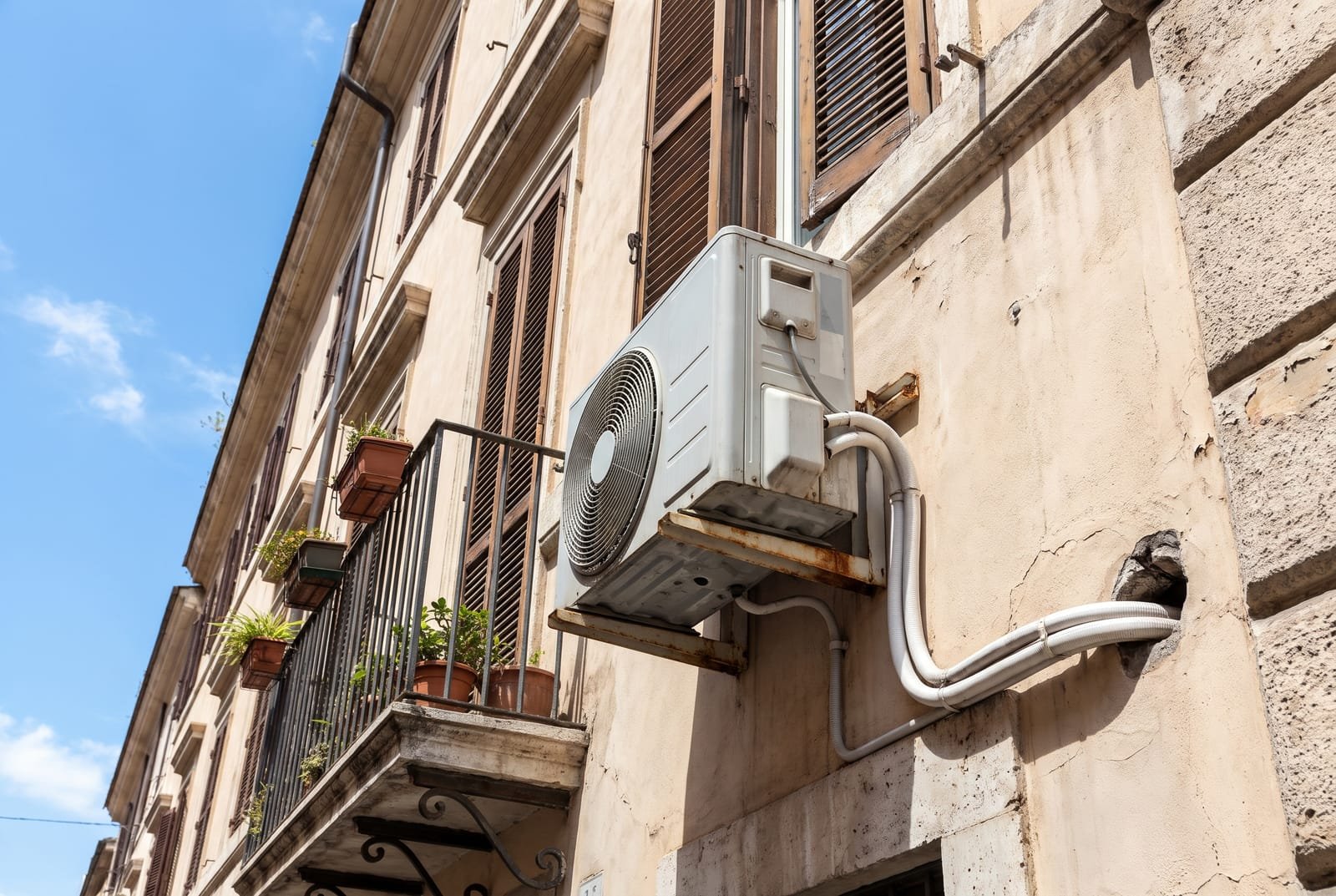

Installation: refrigerant lines or two holes in the wall
Installing a split means fixing the outdoor unit in a suitable place (a balcony, a flat roof or a bracket on the facade), running the refrigerant lines between the two units, and then connecting, evacuating and testing the circuit. In the European Union this kind of work on a refrigerant circuit is reserved for certified technicians, and in the UK the same applies to the fluorinated refrigerants used in most split systems. The job usually takes a few hours, and longer if the pipes have to cover a long distance or be hidden inside the walls.
A unit without an outdoor box arrives with its refrigerant circuit already sealed, filled and tested at the factory, so no refrigerant connections have to be made on site; it still needs a power supply and, on many models, a condensate drain. Installation mainly means drilling two round holes through an exterior wall (usually around 16 to 20 cm in diameter, depending on the model), fixing the mounting bracket and hanging the unit. It is a simpler job, but it is still building work: holes of this size need a core drill and a check that the wall is suitable, so it is worth having it done by a professional.

Good to know: the unit needs an exterior wall, and the exact size and position of the holes and the minimum distances from ceilings, floors and corners are given in the installation manual of each model. Read them before choosing the room.
Efficiency and running costs
Moving the compressor outside gives the split a real advantage: it can use larger heat exchangers and fans, and most models also have an inverter compressor that adjusts its speed to what the room actually needs. This is why the best split systems reach the top energy classes and are usually the cheapest to run for the same amount of cooling.
Air conditioners without an outdoor unit have to fit everything into a compact cabinet, so their efficiency is lower than that of a good split, often by a wide margin. Recent models with inverter technology do better than older fixed-speed ones, but they still fall well short of the most efficient splits. Keep in mind that on the energy label used in the EU and the UK, splits are rated on seasonal efficiency (SEER for cooling, SCOP for heating), while units without an outdoor box are rated at fixed standard test conditions, one for cooling and one for heating (EER and COP). The letters on the two labels are not directly comparable, and neither are the consumption figures: kWh per year on a split label, kWh per 60 minutes on the other. For a rough like-for-like comparison, look at the cooling capacity and the power input in kW in the specifications, bearing in mind that these figures describe a single full-load test and do not show the extra savings an inverter split usually makes at part load.
Noise
With a split, the compressor works outside, so in the room you mostly hear the fan of the indoor unit, which is very quiet at its lowest speed. In a unit without an outdoor box the compressor is just behind the front panel, and even with good soundproofing it is generally easier to hear.
If you plan to use the air conditioner in a bedroom at night, compare the sound levels in dB(A) stated in the specifications, look for a night or silent mode and remember that even a few decibels make a noticeable difference.
Power and room size
Splits are available in a very wide range of capacities, from small units for a bedroom to powerful models for open-plan spaces, and multi-split systems can serve several rooms with a single outdoor unit. Units without an outdoor box usually come in a narrower range and are designed to cool one room of average size. If you need to cool a large living area or several rooms, a split or multi-split system is normally the more suitable solution.
The right capacity depends on the size of the room, its exposure to the sun, the insulation, the windows and how many people use it: a qualified installer can calculate it properly after a quick survey.
Looks, buildings and permissions
This is where units without an outdoor box shine. An outdoor unit is not always welcome: in historic town centres, in listed buildings or in blocks of flats with strict rules about the facade, it may be restricted or need approval, and some homes simply have no balcony or suitable space for it. A unit without an outdoor box leaves only two grilles on the outside, which can often be painted the same colour as the wall.
Two holes in an exterior wall are still a change to the facade, though. Before buying, check the rules of your building and of your local authority, especially if the building is protected.
Heating in winter
Many models of both types are heat pumps that can also heat, and in mild weather they can be an efficient way to warm a room. When the outside temperature drops a lot, splits designed for heating generally keep their performance better, while units without an outdoor box may lose capacity more quickly; some models add an electric heating element to compensate. If heating matters to you, check the operating temperature range and the heating capacity in the specifications.
Both types need the same basic care: cleaning the air filters regularly, usually every few weeks during the season, and a periodic check by a technician. With a split, also make sure the outdoor unit has free space around it and is not covered by leaves or dirt. With a unit without an outdoor box, keep the outside grilles free from obstructions such as plants or nests.
What about portable air conditioners?
Portable air conditioners on wheels are a third family, often confused with units without an outdoor box. They are even easier to set up, because they push hot air out through a flexible hose placed in a window, but they are usually the least efficient and the noisiest option: the compressor sits in the room with you, a window left ajar lets warm air back in, and single-hose models also draw warm outside air in through gaps to replace the air they blow out. They make sense for occasional use rather than as a permanent solution.
Which one is right for you?
A split is usually the best choice if:
- you want the highest efficiency and the lowest running costs;
- quiet in the room is a priority, for example in a bedroom;
- you need to cool a large space or several rooms;
- you have a suitable place for the outdoor unit and you are allowed to install it.
An air conditioner without an outdoor unit makes sense if:
- an outdoor unit is not allowed or not possible, for example in a historic building or a flat without a balcony;
- you want to keep the facade as uncluttered as possible;
- you need to cool one room and the unit can go on an exterior wall;
- you prefer an installation without refrigerant lines between two units.
Frequently asked questions
Does an air conditioner without an outdoor unit work as well as a split?
It cools a room effectively, but for the same capacity it is clearly less efficient and generally easier to hear indoors than a good split. It is a smart solution where a split cannot be installed, rather than a replacement for it in every situation.
Can I install it myself?
The refrigerant circuit does not need to be opened, but drilling two large holes through an exterior wall is serious building work. Follow the manufacturer’s instructions, check the warranty conditions and have it installed by a professional.
Do I need permission?
It depends on where you live and on your building. Both outdoor units and holes in the facade can be subject to planning rules or to the rules of your building, lease or management company, so always check before installing.
Does it also heat?
Many models are heat pumps that can also heat, but their performance in cold weather varies from model to model: check the specifications.
In short
The classic split remains the benchmark for efficiency, quietness and capacity. Air conditioners without an outdoor unit trade some of that efficiency for a simpler installation and a facade without bulky boxes. Start from your home: if an outdoor unit is possible, a split is usually the most efficient choice; if it is not, a unit without an outdoor box is a practical way to enjoy cool air all the same.
This article is for general information only. Specifications vary from model to model: always check the specifications and the installation manual, and ask a qualified installer for advice on your home.